ProportionalityRate of change is proportional to that of the influencing stock |
 |
Diagram
Information
This information is part of the Business Simulation Library (BSL). Please support this work and ► donate.
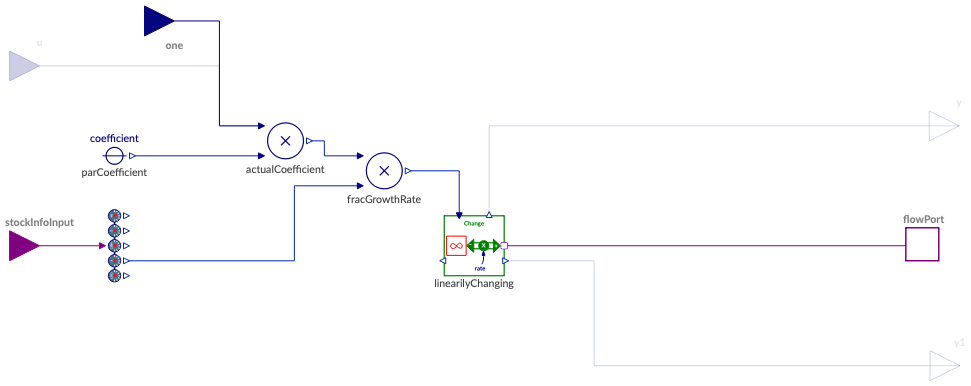
Proportionality expresses the fact that the rate of change for an influenced stock B is proportional to the net rate of change for an influencing stock A, which is connected via the stockInfoInput. The factor of proportionality k is given by the parameter coefficient. The rate of change for the stock B that is connected to the flowPort accordingly is given by the following equation, which uses Newton's dot notation for rates:

Implementation
 |
Notes
- The given coefficient can optionally be multiplied by an exogenous input u.
- By setting
coefficient = 1the input u can be used to provide a variable factor of proportionality.
See also
Parameters (3)
| hasRateOutput |
Value: false Type: Boolean Description: = true, if the rate is reported via real output connectors |
|---|---|
| coefficient |
Value: 1 Type: InputType Description: Constant coefficient |
| hasFactor |
Value: false Type: Boolean Description: = true, if coefficient is to be multiplied with input u |
Connectors (6)
 |
flowPort |
Type: FlowPort Description: Used to represent stock and flow connections |
|---|---|---|
 |
y |
Type: RealOutput Description: Output of current rate of flow |
|
y1 |
Type: RealOutput Description: Output of current rate of flow |
 |
stockInfoInput |
Type: StockInfoInput Description: Input of record with stock-related information |
 |
u |
Type: RealInput Description: Input of factor with regard to coffeficient |
|
one |
Type: RealInput Description: Default factor |
Components (5)
 |
parCoefficient |
Type: ConstantConverter Description: Constant coefficient (optional) |
|---|---|---|
 |
actualCoefficient |
Type: Product_2 Description: Inputs are multiplied |
 |
absoluteSensor1 |
Type: AbsoluteSensor Description: Reports basic stock–related information |
 |
linearilyChanging |
Type: ExogenousChange Description: A stock is filled or drained at a given rate |
|
fracGrowthRate |
Type: Product_2 Description: Inputs are multiplied |
Used in Components (1)
 |
BusinessSimulation.CausalLoop Process driven by proportionality with additional exponential delay |
Revisions
- Introduced in v2.0.0.